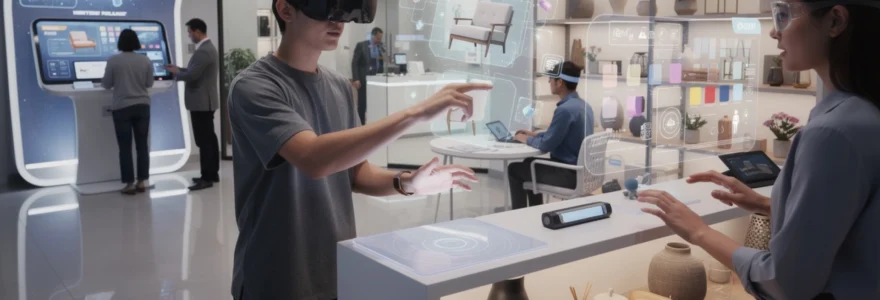
The retail landscape has undergone a seismic shift as brands recognise the power of immersive technologies to create meaningful connections with consumers. Modern shoppers expect more than transactional exchanges—they crave experiences that engage multiple senses and forge emotional bonds with brands. This evolution has given rise to immersive shopping environments that blend cutting-edge technology with traditional retail principles, fundamentally transforming how customers interact with products and make purchasing decisions.
Immersive commerce represents a convergence of virtual reality, augmented reality, artificial intelligence, and sensory technologies that create compelling digital-physical hybrid experiences. These innovations enable retailers to overcome the limitations of both pure digital and traditional brick-and-mortar channels, offering customers unprecedented ways to explore, evaluate, and connect with products. The impact extends far beyond novelty—immersive shopping experiences drive measurable improvements in customer engagement, conversion rates, and brand loyalty metrics.
Virtual reality and augmented reality technologies in retail environments
The integration of virtual and augmented reality technologies has revolutionised how retailers present products and engage customers. These immersive retail technologies create three-dimensional environments where shoppers can interact with products in ways previously impossible, bridging the gap between digital convenience and physical product experience. Leading retailers report conversion rate increases of up to 94% when implementing AR try-on features, whilst VR showrooms extend average session durations by 300% compared to traditional e-commerce platforms.
The sophistication of modern VR and AR implementations goes beyond simple product visualisation. Advanced systems now incorporate real-time physics simulations, photorealistic rendering, and spatial computing capabilities that create convincing digital environments. Retailers leverage these technologies to offer virtual store tours, product customisation interfaces, and collaborative shopping experiences that multiple users can share simultaneously, regardless of their physical locations.
Oculus rift integration in IKEA place application architecture
IKEA’s pioneering use of Oculus Rift technology demonstrates how enterprise-grade VR can transform furniture retail experiences. The system allows customers to walk through fully furnished virtual rooms, experiencing spatial relationships and proportions that static images cannot convey. The integration utilises advanced room-scale tracking and haptic feedback to create authentic spatial experiences, enabling customers to gauge furniture dimensions against their physical spaces with remarkable accuracy.
The technical architecture behind IKEA’s VR implementation showcases sophisticated data synchronisation between product catalogues, 3D asset libraries, and real-time rendering engines. This seamless integration ensures that virtual representations maintain consistency with physical products, whilst dynamic lighting and material rendering create realistic visual experiences that build customer confidence in purchase decisions.
Microsoft HoloLens deployment for In-Store product visualisation
Microsoft HoloLens has emerged as a powerful platform for mixed reality retail applications, particularly in categories where product context matters significantly. Fashion retailers use HoloLens to overlay digital garments onto customers’ reflections, whilst home improvement stores enable customers to visualise renovations within their actual living spaces. The technology’s ability to anchor digital objects to physical environments creates intuitive interfaces that feel natural to users without extensive technical knowledge.
The deployment of HoloLens in retail environments requires careful consideration of spatial mapping, gesture recognition, and voice command integration. Successful implementations focus on creating workflows that complement rather than complicate existing shopping behaviours, using the technology to enhance decision-making processes rather than creating entirely new interaction paradigms.
Webxr implementation strategies for Cross-Platform shopping experiences
WebXR represents the future of accessible immersive retail, eliminating the need for dedicated applications or hardware whilst delivering sophisticated AR and VR experiences through standard web browsers. This approach dramatically reduces barriers to adoption, as customers can access immersive features directly from product pages without additional downloads or installations. Progressive web applications built with WebXR frameworks achieve loading times under three seconds whilst maintaining high-fidelity 3D experiences.
The strategic implementation of WebXR requires optimisation for diverse device capabilities and network conditions. Retailers employ adaptive streaming techniques that dynamically adjust 3D asset quality based on device performance and connection speeds, ensuring consistent experiences across premium smartphones and budget devices alike.
Unity 3D engine optimisation for Real-Time product rendering
To achieve responsive, real-time product rendering in immersive shopping environments, retailers often rely on the Unity 3D engine as the core runtime. Unity’s rendering pipeline can be tuned to balance visual fidelity with performance, using techniques such as level-of-detail (LOD) management, baked lighting, and GPU instancing to handle large catalogues of 3D products without compromising frame rates. For high-converting immersive shopping experiences, maintaining a stable 60–90 frames per second is critical, as any noticeable lag or stutter can break immersion and reduce customer engagement.
Performance optimisation begins with the way 3D assets are created and imported into Unity. Retailers collaborate with 3D artists to standardise polygon counts, texture resolutions, and material usage, ensuring that assets are lightweight yet photorealistic. Developers then configure Scriptable Render Pipelines (SRP) such as URP or HDRP based on target devices, applying dynamic resolution scaling and occlusion culling to reduce unnecessary draw calls. Combined with asset bundling and content delivery networks, these optimisations enable fast-loading, visually rich product experiences across headsets, kiosks, and mobile WebXR sessions.
Haptic feedback systems and multi-sensory customer touchpoints
Immersive shopping experiences become truly transformative when they engage more than just sight and sound. Haptic feedback, olfactory marketing, and spatial audio add layers of realism that help customers feel as though they are interacting with physical products rather than digital proxies. In a world where online shopping often lacks tangibility, these multi-sensory customer touchpoints recreate the subtle cues—texture, weight, ambience—that support confident purchase decisions.
Multi-sensory retail is particularly effective for categories where physical feel and atmosphere drive value perception, such as luxury fashion, beauty, furniture, and automotive. By integrating advanced haptic feedback systems with immersive retail technologies, brands can simulate everything from the click of a lipstick case to the thud of a car door. This blend of sensory cues not only deepens engagement but also increases dwell time and brand recall, creating a differentiated customer journey that competitors struggle to replicate.
Ultraleap hand tracking technology for contactless product interaction
Ultraleap hand tracking technology enables customers to interact with virtual products through natural gestures, without the need for physical controllers or touchscreens. Mounted above kiosks or embedded in digital displays, Ultraleap sensors capture hand and finger movements with high precision, allowing shoppers to rotate, resize, and customise 3D objects in mid-air. This type of contactless product interaction has become especially attractive in the post-pandemic era, where hygiene concerns influence in-store behaviour.
For retailers, the value of Ultraleap extends beyond novelty. Gesture-based interfaces reduce hardware wear and tear, simplify cleaning routines, and minimise friction for first-time users who might be intimidated by traditional controllers. By mapping intuitive gestures—such as pinch to zoom or swipe to browse—onto common shopping actions, you can create immersive shopping journeys that feel more like interacting with a physical object than navigating a user interface. Analytics from these systems also reveal which gestures and products drive the most engagement, supporting continuous optimisation.
Tanvas surface haptics integration in digital display systems
Tanvas uses surface haptics to simulate different textures on otherwise smooth touchscreens, giving customers the sensation of rough fabrics, embossed packaging, or ridged controls under their fingertips. When integrated into digital display systems, Tanvas haptics transforms product exploration from a purely visual activity into a tactile experience, even in a fully digital environment. Imagine browsing a catalogue of handbags and feeling the difference between pebbled leather and suede through a single interactive table.
From an implementation perspective, retailers map haptic effects to specific product attributes in their content management systems. As customers slide their fingers across product images, Tanvas hardware adjusts friction patterns on the glass to match the virtual material. This precise control enables brands to tell richer product stories—for example, highlighting the premium weave of a designer fabric or the fine grain of a wooden surface. In experiential retail spaces, such tactile storytelling can be the difference between passive browsing and active, emotionally charged engagement.
Olfactory marketing through ScentAir delivery mechanisms
Scent is one of the most powerful triggers of emotion and memory, making olfactory marketing a potent tool for immersive retail. ScentAir and similar scent delivery systems allow brands to infuse spaces with carefully crafted fragrances that align with their identity and product lines. A sports retailer might choose a crisp, energising scent reminiscent of fresh air and rubber tracks, while a luxury boutique opts for warm, layered notes that evoke exclusivity and comfort.
ScentAir devices can be centrally controlled and integrated with building management systems or experiential platforms, enabling dynamic scent scenarios that change throughout the day or in response to specific events. For instance, you can synchronise fragrance changes with seasonal collections, live shopping events, or virtual store “zones” to reinforce thematic storytelling. When combined with AR and VR experiences, olfactory cues help bridge the gap between digital scenes and physical sensations, making virtual environments feel more believable and emotionally resonant.
Spatial audio implementation using dolby atmos technology
Spatial audio, particularly through Dolby Atmos, adds a three-dimensional soundscape to immersive shopping environments, guiding customer attention and heightening realism. Instead of simple stereo tracks, Dolby Atmos allows sound designers to position audio objects in 3D space, so that footsteps, product sounds, or ambient music appear to originate from specific directions. In a virtual showroom, this means you can hear a barista steaming milk behind you or a car engine revving to your left, just as you would in a physical space.
Retailers implement spatial audio in both VR environments and physical installations, using ceiling speakers or directional soundbars to create zones of focused audio without bleeding into the entire store. Strategically placed sounds can subtly direct customers toward featured displays or interactive experiences, functioning like an audio version of wayfinding signage. When harmonised with lighting, visuals, and haptics, Dolby Atmos reinforces the sense of presence that makes immersive shopping experiences feel authentic and emotionally engaging.
Personalisation algorithms and AI-driven customer journey mapping
Immersive technologies become far more powerful when combined with AI-driven personalisation and customer journey mapping. Rather than offering the same virtual store or AR experience to every visitor, retailers can tailor content, layout, and recommendations based on real-time behaviour and historical data. In practice, this means that two customers entering the same virtual showroom may see different product assortments, navigation paths, and interactive prompts—each optimised for their unique preferences and intent.
As customer journeys span mobile apps, in-store kiosks, VR headsets, and traditional websites, AI plays a crucial role in stitching these touchpoints into a coherent narrative. Advanced algorithms analyse clickstreams, gestures, dwell times, and speech patterns to infer what each shopper is trying to achieve. With this insight, you can serve context-aware suggestions—such as offering a complementary product demo in VR or surfacing an AR “try it at home” prompt right when a customer hesitates. The outcome is an immersive shopping experience that feels less like a scripted tour and more like a responsive, intelligent conversation.
Machine learning models for Real-Time behavioural pattern recognition
Real-time behavioural pattern recognition relies on machine learning models that continuously ingest and interpret user interactions across channels. These models track signals such as how long customers examine a 3D product, which features they customise, and where they abandon a virtual journey. Over time, patterns emerge that highlight high-intent behaviours—like repeatedly toggling colour options on a sofa—or early indicators of churn, such as frequent backtracking between steps.
Retailers deploy streaming analytics pipelines and lightweight models at the edge to ensure instant responses within immersive environments. When a model detects strong purchase intent, it might trigger a personalised discount, a live-assistance offer, or a comparison view to help the customer commit. Conversely, if it recognises confusion or disengagement, the system can simplify the interface or provide guided tours. This level of real-time adaptation is what elevates immersive shopping from a static 3D brochure to a truly interactive, customer-centric experience.
Computer vision analytics through amazon rekognition integration
Computer vision, powered by platforms such as Amazon Rekognition, enables retailers to understand how customers physically and virtually interact with products. In-store cameras, when used responsibly and with clear consent, can capture anonymised data on foot traffic, gaze direction, and engagement with displays. In immersive digital environments, the same technology can analyse where users focus their attention within a VR scene or which angles of a 3D product they inspect most often.
By integrating Amazon Rekognition with retail analytics systems, you can correlate visual engagement with sales outcomes to refine layouts and content. For example, if vision data shows that customers consistently look at the interior of a car in VR but rarely at the wheels, you might adjust camera paths or highlight different features. Computer vision also supports safety and accessibility, detecting overcrowded areas in physical stores or monitoring body posture to minimise motion sickness in VR showrooms. When combined with traditional behavioural data, these insights enrich customer journey mapping and inform smarter merchandising decisions.
Natural language processing for voice commerce optimisation
As voice assistants and smart speakers proliferate, natural language processing (NLP) has become essential for optimising voice commerce within immersive shopping environments. Customers increasingly expect to speak naturally—asking questions, requesting product comparisons, or seeking help—rather than relying solely on menus and buttons. NLP models interpret these requests, extract intent and entities, and route queries to the right content or action in real time.
In VR and AR contexts, voice commands can dramatically simplify navigation and interaction. Instead of fumbling with controllers or gesture menus, a shopper can say, “Show me this sofa in dark blue,” or “Compare this model with a cheaper alternative.” Retailers train NLP systems on domain-specific vocabularies, brand names, and product attributes to increase accuracy and reduce friction. Pairing voice input with visual confirmations—such as highlighting the selected item—also builds trust, helping customers feel in control of their immersive shopping experience.
Predictive analytics using TensorFlow for purchase intent scoring
Predictive analytics models built with frameworks like TensorFlow help retailers estimate purchase intent at various points in the customer journey. By training models on historical data—browsing patterns, interaction depth with AR features, response to offers, and prior purchase behaviour—you can generate a dynamic score that represents how likely a given customer is to convert. This score updates in real time as new signals arrive from immersive touchpoints.
High purchase intent scores can trigger proactive interventions, such as offering 1:1 virtual consultations, unlocking premium AR visualisations, or prioritising customers for limited inventory. Conversely, low or declining scores may prompt re-engagement campaigns or simplified experiences to reduce cognitive load. Importantly, predictive models not only improve conversion rates but also help allocate resources—such as live agents and compute-intensive VR features—to the customers and moments where they will have the greatest impact. Over time, these insights feed back into journey mapping, making your entire immersive commerce strategy more efficient and customer-centric.
Omnichannel integration and cross-platform data synchronisation
Immersive shopping experiences deliver the most value when they are fully integrated into your broader omnichannel retail strategy. Customers should be able to start exploring products in a virtual showroom, continue on a mobile app with AR visualisation, and complete their purchase in-store—without losing context or having to repeat steps. Achieving this requires robust cross-platform data synchronisation, so that preferences, wish lists, configurations, and interaction histories travel with the customer across every channel.
From a technical standpoint, retailers are increasingly adopting composable architectures and customer data platforms (CDPs) that centralise profiles and event streams. APIs expose this unified data to VR engines, mobile apps, e-commerce sites, and in-store systems, ensuring that each touchpoint reads from the same “source of truth.” For example, when a shopper customises a pair of trainers in a VR experience, the design is stored as a configuration object that can be accessed later via QR code in-store or through an email link. This kind of continuity is what turns isolated immersive moments into a cohesive, high-performing omnichannel journey.
Performance metrics and ROI analysis for immersive commerce implementations
As with any significant technology investment, immersive commerce initiatives must be measured against clear performance metrics and ROI goals. Beyond traditional KPIs like conversion rate and average order value, immersive shopping experiences introduce new indicators such as engagement depth, interaction diversity, and sensory impact. Retailers track metrics including time spent in VR showrooms, number of AR try-ons per session, completion rates of guided experiences, and the influence of haptic or audio cues on product selection.
To quantify return on investment, you can compare cohorts exposed to immersive experiences against control groups using standard e-commerce interfaces. Key measures often include reduced product returns (thanks to better visualisation and fit assessment), higher NPS scores, and increased repeat purchase rates. Some brands also attribute value to softer outcomes like social media amplification, as customers share screenshots or videos of their immersive journeys. By building a structured analytics framework—and validating results over multiple campaigns—you create a business case that supports scaling immersive technologies across categories and regions.
Future trends in neural commerce and brain-computer interface applications
The next frontier of immersive shopping lies at the intersection of neuroscience and commerce, often referred to as neural commerce. Emerging brain-computer interface (BCI) technologies promise to capture cognitive and emotional states—such as attention, excitement, or fatigue—directly from neural signals. While still in early stages, these tools could eventually allow retailers to test and refine immersive store layouts, content, and interactions based on how the brain actually responds, rather than relying solely on clicks and surveys.
In the long term, non-invasive BCIs combined with VR headsets may enable entirely new interaction paradigms, where customers navigate virtual stores or select products using subtle neural signals instead of physical gestures or voice commands. This could be transformative for accessibility, opening up immersive commerce to shoppers who cannot easily use traditional input devices. Ethical considerations will be crucial: brands must ensure transparency, consent, and strict data protection when dealing with neural data. As these technologies mature, retailers that experiment thoughtfully—balancing innovation with responsibility—will be best positioned to harness neural commerce as the next wave of immersive customer engagement.